
Research Multiphase and index-matched flows
The gentle slope is the expensive one
Widen a pipe with a smooth 45° taper and it should treat the flow more kindly than a blunt 90° step. It does not. The gentle expansion makes more turbulence, spreads it wider, and costs more pressure. Engineers have designed around this for a century without anyone watching it happen.
Stereo PIV — the settled picture
High-speed PIV — the moving picture
The puzzle
A design rule nobody had watched happen
Gibson measured it in 1910. It has been in the handbooks ever since.

That curve is one of the oldest results in pipe design. Open a pipe out too gently and the loss climbs; open it abruptly and the loss falls back. Beyond roughly 16° in a circular pipe, a square step is the cheaper choice.
It is a strange thing to design around for a hundred years without knowing the cause. The measurements it rests on are pressure drops across the fitting, which tell you what the flow costs but nothing about what the flow does.
A well-known design rule that nobody had watched happen.
Why it is hard
You cannot see inside a round pipe
A curved acrylic wall works as a lens, and bends the measurement out of shape.
Optical measurement needs a clear view of the tracer particles. A round pipe refuses to give one: the curved wall bends every ray that crosses it, so the particles appear displaced from where they really are. This is why a geometry as ordinary as a widening pipe has so little direct flow data behind it.
The fix is to make the wall optically disappear, by tuning the liquid until it bends light exactly as much as the acrylic does. It is the same trick that lets us measure the flow around freely rising spheres, used here on the pipe instead of the body inside it.

Index matching turns an opaque geometry into a measurable one.
What happens
The return flow decides everything
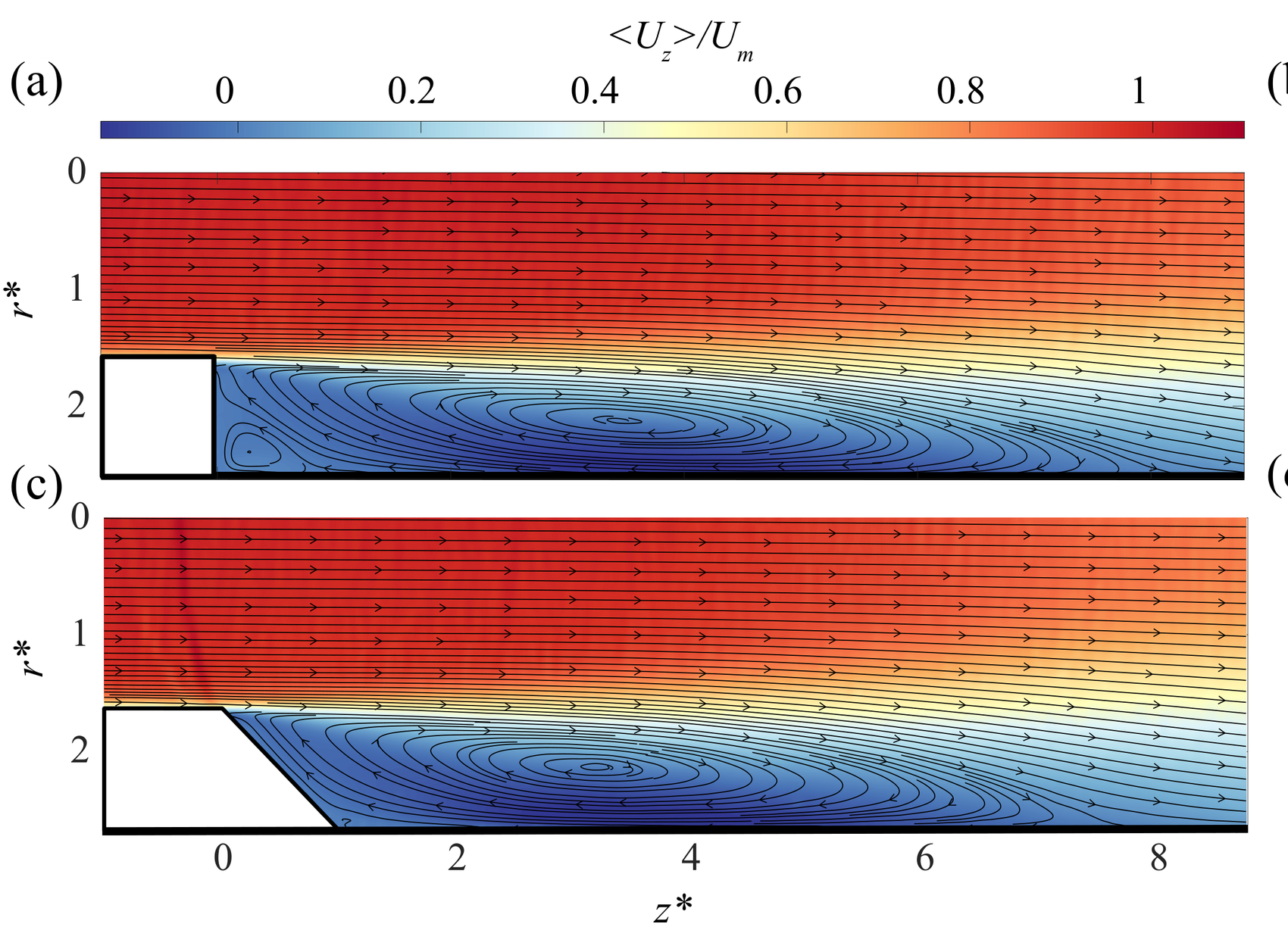
Both geometries recirculate. What differs is how that returning fluid gets back to the corner.

Follow the returning fluid. In the wedge it runs back along the slope, keeps its momentum, and arrives at the corner still moving fast, meeting the oncoming stream at a sharp angle. In the step it has to negotiate a second, counter-rotating vortex parked in the corner; it separates around that obstacle and arrives weakened and turned.
That single difference sets everything that follows. Where the two streams meet head on, they fight; where one arrives softened, they do not.

For the specialist
Area ratio 2.56, from 25 mm to 40 mm diameter, giving a step height of 7.5 mm. Step-height Reynolds numbers of 25,000 and 35,000, corresponding to inlet speeds of 3.6 and 5.1 m/s. Working fluid sodium iodide at 62–63%, refractive index 1.488. Two 25 megapixel cameras, 3,000 snapshots over 200 seconds; vector resolution 217 µm, or 54 µm with sum-of-correlation, about 1.26 times the Kolmogorov scale. A counter-rotating secondary vortex forms in the corner of the step cases and is absent in the wedge cases. Reattachment occurs five to eight step heights downstream.
Geometry sets how the returning flow meets the oncoming flow, and that sets the turbulence.
The consequence
A broader shear layer, and more of it sideways
The wedge spreads its turbulence over a wider region and pushes more of it out of the plane.

Because the return flow cannot punch through the oncoming stream, it is squeezed sideways instead. Right at the corner that sideways motion dominates: as much as 80% of the turbulent energy there is in the out-of-plane direction, around the pipe rather than along it. That is energy taken from the mean flow and never recovered, which is exactly what a loss coefficient measures.


The gentle geometry makes more turbulence, over a broader region, and pays for it in pressure.
What moves Under review
Slow and long-lived, or fast and fleeting
The two geometries do not just make different amounts of turbulence. They move it differently.

In the step, individual structures hold together far longer, persisting for 15 to 18 milliseconds against roughly 5 in the wedge, but they travel slowly, at 57 to 67 per cent of the inlet speed. The wedge is the opposite: short-lived structures moving fast, at 75 to 95 per cent.
By the time the flow has reattached to the wall, the difference has gone. Both geometries settle to 35 to 42 per cent, and downstream of that point you could not tell them apart.
For the specialist
Streamwise integral time scales are 15–18 ms in the step against approximately 5 ms in the wedge, with the same ordering at both Reynolds numbers. Space–time correlations give convection velocities Uc/Um = 0.57–0.67 for the step and 0.75–0.95 for the wedge. Toward reattachment, Uc/Um narrows to 0.35–0.42 for all four cases. The broader step correlation ridges are associated primarily with stronger radial variation of the local convection velocity rather than systematically stronger local decorrelation.
Expansion geometry matters most right at the corner and washes out downstream.
Why it matters
Every piping system is full of these
An expansion is one of the commonest fittings there is, and the choice between a taper and a step is made on cost and space as often as on physics. The turbulence it generates sets the pressure a pump has to supply, decides whether particles carried in the flow stay suspended or settle out in the corner, and governs how well two streams mix downstream of the joint.
If you must widen a pipe and you cannot do it very gradually, do it abruptly.
Read the papers
Physical Review Fluids 11(3), 034607 (2026)
Effect of expansion geometry on turbulence in axisymmetric pipe flows
The mean flow, the shear layers and the turbulent stresses in both geometries, and the return-flow mechanism that explains the loss curve.
Companion study, currently under review: Coherent structure transport in turbulent axisymmetric pipe expansions — Physical Review Fluids, arXiv:2603.19457. Jibu Tom Jose, Gal Friedmann and Omri Ram. How long the structures last and how fast they travel.
This work was supported by the American Chemical Society Petroleum Research Fund New Directions Grant 65901-ND9. Jibu Tom Jose was supported by a Technion postdoctoral fellowship.