
Transient Fluid Mechanics Laboratory
The physics of
a split second.
Shock waves, cavitation, bubbles, and bodies moving through their own wakes: we build experiments that resolve fluid motion lasting microseconds to milliseconds.
Explore our researchFaculty of Mechanical Engineering Technion, Haifa Founded 2021

measurable.↗
Curiosity,
in motion.
01 / Research
All researchFast events.
Open questions.
Two lines of work run through the lab: compressible flows and shock waves, and multiphase flows made visible by refractive index matching. Both rest on time-resolved measurements of events that are over in less than a second.
-
 01
01Compressible flows
Shock waves through abrupt area changes
Reflections, vortex formation and the long recovery to a uniform front, resolved in experiments and large-eddy simulation.
Read about the project -
 02
02Multiphase flows
Forces on a sphere that cannot be seen
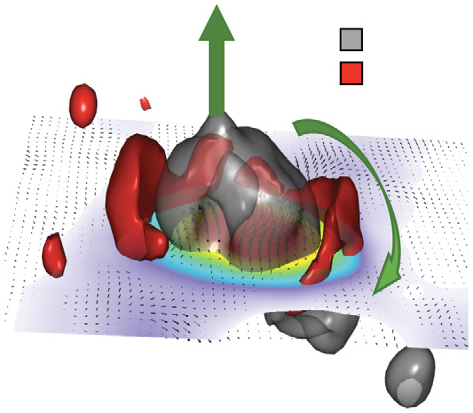
An index-matched sphere is invisible to our cameras. We locate it from the flow it disturbs and measure the drag and lift on it as it rises.
Read the story -
 03
03Cavitation & interfaces
The inception of attached cavitation
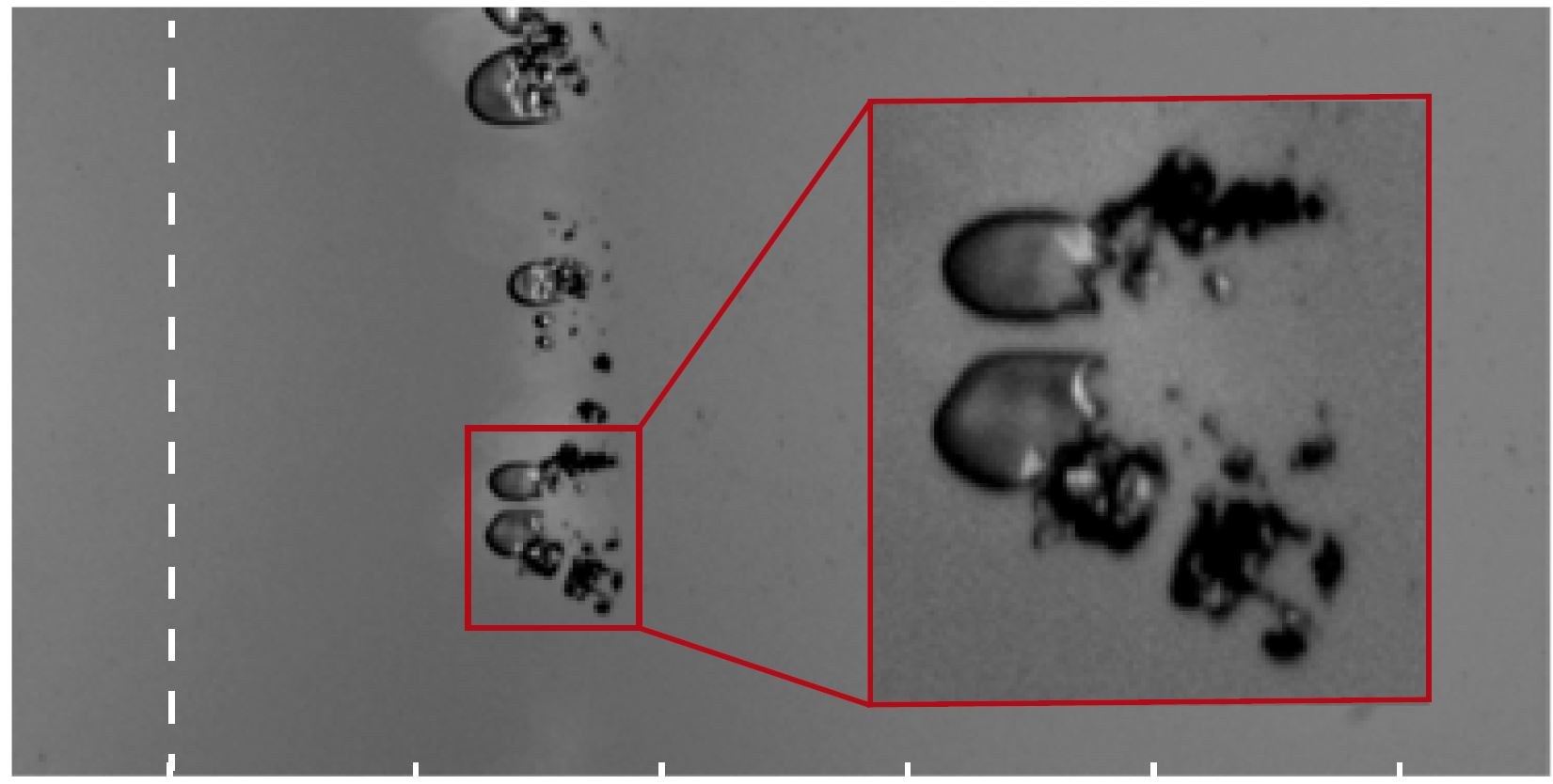
Microbubbles trapped near the wall seed each new cavitation event, which is why inception barely depends on the nuclei in the free stream.
Read about the project
02 / A measurement
A rising sphere,
frame by frame.
A buoyant sphere does not rise in a straight line. The vortices it sheds pull on it, and its path wanders.
These ten snapshots from a single experiment follow the wake over 220 milliseconds: two vortex threads form, stretch and break into rings, and the drag on the sphere rises and falls with them.
How the measurement was made- 4,800
- frames per second
- 4
- camera views
- 11.11 mm
- sphere diameter
03 / News
All news
04 / People
The people behind
the measurements.
We are engineers and physicists who build our own experiments: the shock tube, the index-matched flow loops, the optics and the software that runs them.
The lab is led by Omri Ram, assistant professor in the Faculty of Mechanical Engineering, who trained in shock-wave physics at Ben-Gurion University and in experimental fluid mechanics at Johns Hopkins University.


Open positions
Work
with us.
We take M.Sc. and Ph.D. students, postdoctoral fellows and undergraduate researchers who want to build the experiment as well as run it.
Positions, what we look for and how to apply are on the Join page.
How to apply