
Research Compressible flows and shock waves
Shock waves through abrupt area changes
A shock wave runs down a duct. The duct gets taller. The shock bends, slows, and starts bouncing between the walls. Two metres later it is flat again.
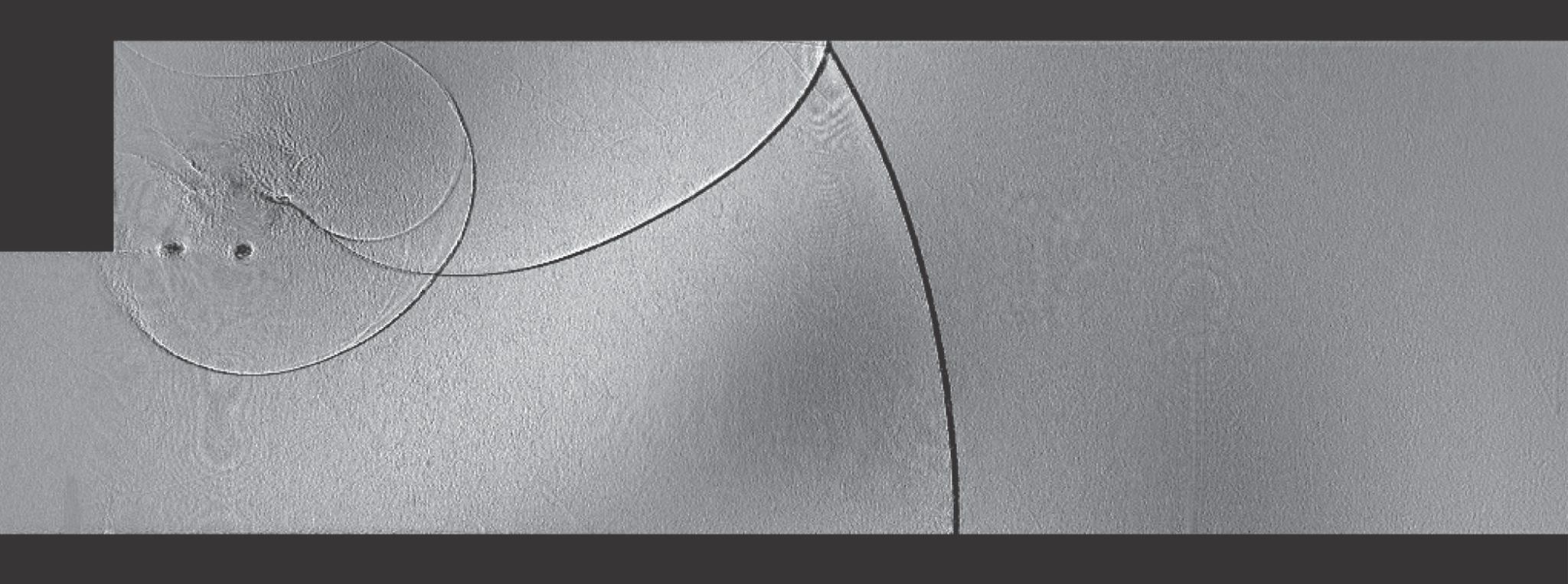
A shock meets a step
A shock in a straight duct is flat. Every part of it travels at the same speed, and the pressure behind it is the same everywhere.
The step breaks that. Near the corner the shock suddenly has room to spread sideways, so it curves and slows. The rest of the front follows, until the whole thing is curved and much slower than it was. It reaches the far wall and reflects — cleanly at first, then, as the angle grows, into a shape with a sharp kink in it. That kink is a triple point, and everything after this is its story.

Within a third of a millisecond, one flat shock has become four or five, interacting with each other, with the walls, and with the flow behind them.
For the specialist
Experiments run in a 40 × 40 mm shock tube fitted with an unusually long 2 m test section, with schlieren at up to 140 kHz from two Phantom V2640 cameras interleaved by half a frame, and 26 flush-mounted PCB transducers sampled at 250 kHz. The frames above are M = 1.7, H = 70 mm, H/h = 1.75. The induced flow (221 m s⁻¹) separates at the sharp corner into a strong corner vortex. The shock impinges on the top wall at t ≈ 0.13 ms as a regular reflection; RR→MR transition follows at t ≈ 0.16 ms, giving a Mach stem, triple point and slip line. At t ≈ 0.15 ms the first reflected shock hits the corner vortex, and that interaction launches a second incident shock with its own reflection pattern. The vortex disperses by about 1.3 ms, leaving a shear layer, a recirculation region and standing lambda shocks.
The triple point reverberates between the walls
The triple point starts at the top wall and travels down across the front. When it reaches the bottom wall it reflects and heads back up. It does this over and over as the shock runs downstream.

Each bounce speeds up the part of the front near the wall it struck. That part then slows down again — but never all the way back to where it started. The next bounce shoves a different part, and the one after that returns to the first, a little less hard.
Run it back and forth enough times and the fast parts and the slow parts even out. The front stops being lopsided, not because anything smooths it, but because the triple point keeps carrying momentum from the part that has too much to the part that has too little. That is the mechanism, and it is the paper's main result.
Every bounce also leaves a shock behind, so a train of them builds up in the shock's wake and keeps growing as it goes.

For the specialist
Tracking the triple point and both wall intersections gives uTP, Vs,t and Vs,b, with uTP lying between the two throughout. Each impingement produces a sharp rise at that wall and a slower decay, with progressively smaller increments, converging on a pseudo-steady uTPss. Larger H lengthens the interval between impingements and lowers uTPss; larger M shortens it and raises it. Positions scale on H and velocities on uTPss, which collapses the separate experiments onto one curve. Ensemble maps taken 1 mm behind the triple point show why it decays: moving away from a wall, it enters gas at lower pressure and lower sound speed.
Watch it happen
The first clip is the experiment, with the camera following the shock down the tube; watch the kink cross from one wall to the other. The second is the simulation, which shows the whole duct at once — something no camera can do. Both are sped up.
The duct rings after the shock has gone
A transducer set into the wall sees the front arrive as one clean step up in pressure. Then it sees jump after jump, for milliseconds, as the train passes over it.
Further downstream the jumps get weaker but last longer, because the train keeps growing. And the transducer directly opposite, in the other wall, sees its jumps at different moments. The duct is being shaken from side to side rather than squeezed, which is a harder thing for a structure to take. For a real duct, that ringing matters more than the shock that started it.

For the specialist
At x = 685 mm the wall records sharp jumps for about 2.5 ms; at x = 1464 mm they are weaker but still arriving after 4.5 ms, when the useful run ends. The pressure field settles into three regions: rapid depressurisation and recirculation behind the step; a recovered, nearly uniform stretch whose residual unsteadiness comes from the shear layer, not shocks; and the shock-train region just behind the front, where the transient loading is. Raising the expansion ratio gives fewer jumps but larger ones. Even beyond 25H, no truly steady pressure field was measured.
Where it ends up
Counted in heights of the widened duct, the front takes about fifteen to seventeen of them to become uniform. Below that distance, whatever is bolted to the wall is still being hit unevenly.
What you need before any of that is usable is the speed the shock finally settles at. Simulations across the whole parameter space supplied it, as a single relation.

M sub s s is approximately equal to the ratio H over h raised to the power n, times the quantity M minus one, plus one.
The dashed lines are a much cheaper model, which treats the shock as a surface and works out how fast each piece should travel from the shape of the space ahead of it. For a duct that opens out gently that is a fair trade, because little happens behind the front. For a step it is not: the model tracks the first diffraction, then runs the shock too fast, because it cannot see the triple point come back.
For the specialist
n = −0.42 for a gradual expansion and −0.48 for a step, from power-law fits to the slopes of (Mss − 1) against (M − 1) across 48 simulated configurations of each geometry, M = 1.1–1.8 and H/h = 1–5. Both coefficients are empirical and hold only inside that range. The front becomes uniform at roughly 15H for M = 1.4 and 17H for M = 1.7; at M = 1.7 with H = 130 mm it has still not settled within the 2 m test section. GSD solves Whitham's A–M rule with the Ridoux transverse correction; it diverges once Mach reflection forms, having no coupling to the post-shock flow, and overpredicts the downstream Mach number by under 6 %, worst at H/h = 5 and M = 1.8 (1.46 against 1.38). The LES uses sixth-order optimised upwind reconstruction with a monotonicity-preserving limiter, an HLLC solver and third-order TVD Runge–Kutta, on 120 million cells across four NVIDIA A100 GPUs.
Read the paper
Journal of Fluid Mechanics 997, A30 (2024), open access
The dynamics of shock wave propagation far downstream of an abrupt area expansion
The figures and clips on this page come from that article, published open access under a CC BY 4.0 licence.
A related question — what happens when a duct narrows instead of widening — has its own page: Shock interaction with local constrictions.
This work was supported by the Israel Science Foundation (grant 3113/21) and the Zuckerman STEM Leadership Program. Jibu Tom Jose was partially supported by a Technion postdoctoral fellowship. Computational resources were provided by the CFDLAB at the Technion.
Work with us
If this is the kind of problem you want to spend a few years on, we would like to hear from you.