
Research Compressible flows and shock waves
Shock interaction with local constrictions
Systematic experiments and simulations of shocks passing through short constrictions, from abrupt rectangular blocks to smooth sinusoidal narrowings.
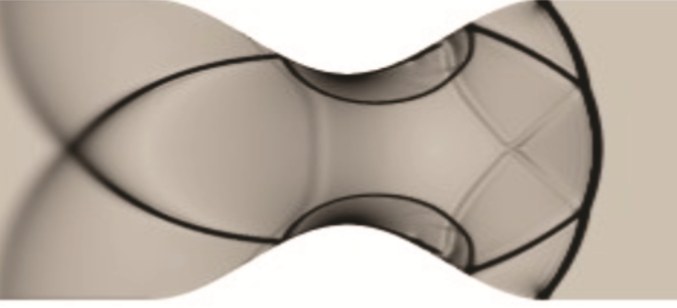
Using experiments and simulations, we study how shock waves interact with localized constrictions in a straight conduit: the cross-section narrows and then returns to its original size over a short distance. By varying the blockage ratio and the length of the narrowing, and by comparing abrupt rectangular constrictions with smoothly contoured sinusoidal ones, we uncover how geometry controls the reflected and transmitted shocks, the flow separation inside the throat and the pressure patterns downstream.
Validated large-eddy simulations resolve both the short-lived start-up process inside the constriction and the later propagation of the reflected and transmitted shocks. The start-up, a sequence of reflection, separation and flow reorganization events, lasts one to two orders of magnitude longer than the shock passage itself.
What we found. For rectangular constrictions the reflected shock strength depends almost only on the blockage ratio and hardly at all on length, while the transmitted shock is measurably sensitive to length. For sinusoidal constrictions the coupling is reversed: the reflection process is governed by the local slope of the contour, so the reflected shock depends on both blockage and length. At late times the reflected shock Mach number scales linearly with blockage ratio and the transmitted shock weakens monotonically with increasing blockage, trends we capture with semi-empirical models that predict both shock strengths across the parameter space. These results give a unified framework for shock propagation in conduits with localized geometric variations, relevant to propulsion systems, blast mitigation and transient flows in complex piping.