
Research Multiphase and index-matched flows
Seeing the flow right next to a moving body
Measure a flow with particles and you get velocity at scattered points. Smoothing those into a field is routine, until a solid body sits in the middle of it. Then the method quietly invents a flow where the body is, and never learns that fluid touching a surface has to travel with it.
The problem
Every reconstruction assumes the world is all fluid
The assumption breaks in the one place you cannot afford to lose it.
Smoothing scattered velocities onto a grid is routine in open water. Put a solid body in the middle and two things go wrong at once. The method fills the body with a flow that does not exist, and it never learns that fluid touching the surface must move with the surface.
That thin region is where the flow changes fastest, and pressure, drag and lift are all worked out from how fast it changes. For a body that moves it is worse: a point that is solid in one frame is open water in the next.
The worst-reconstructed part of the measurement is the part you most want.
The idea
Tell the reconstruction where the body is
Every frame, sort each grid point by how far it sits from the surface, then act on that.
- The shell is told to move with the body, so fluid at the surface travels with the surface.
- Conservation of mass is applied only where there is actually fluid.
- A point the body has just vacated is told to forget what it held a moment ago.

The body stops being a hole in the data and becomes part of the problem.
Does it work
Testing against a flow we already know
A simulated rising sphere gives a complete reference field, which no experiment can offer.
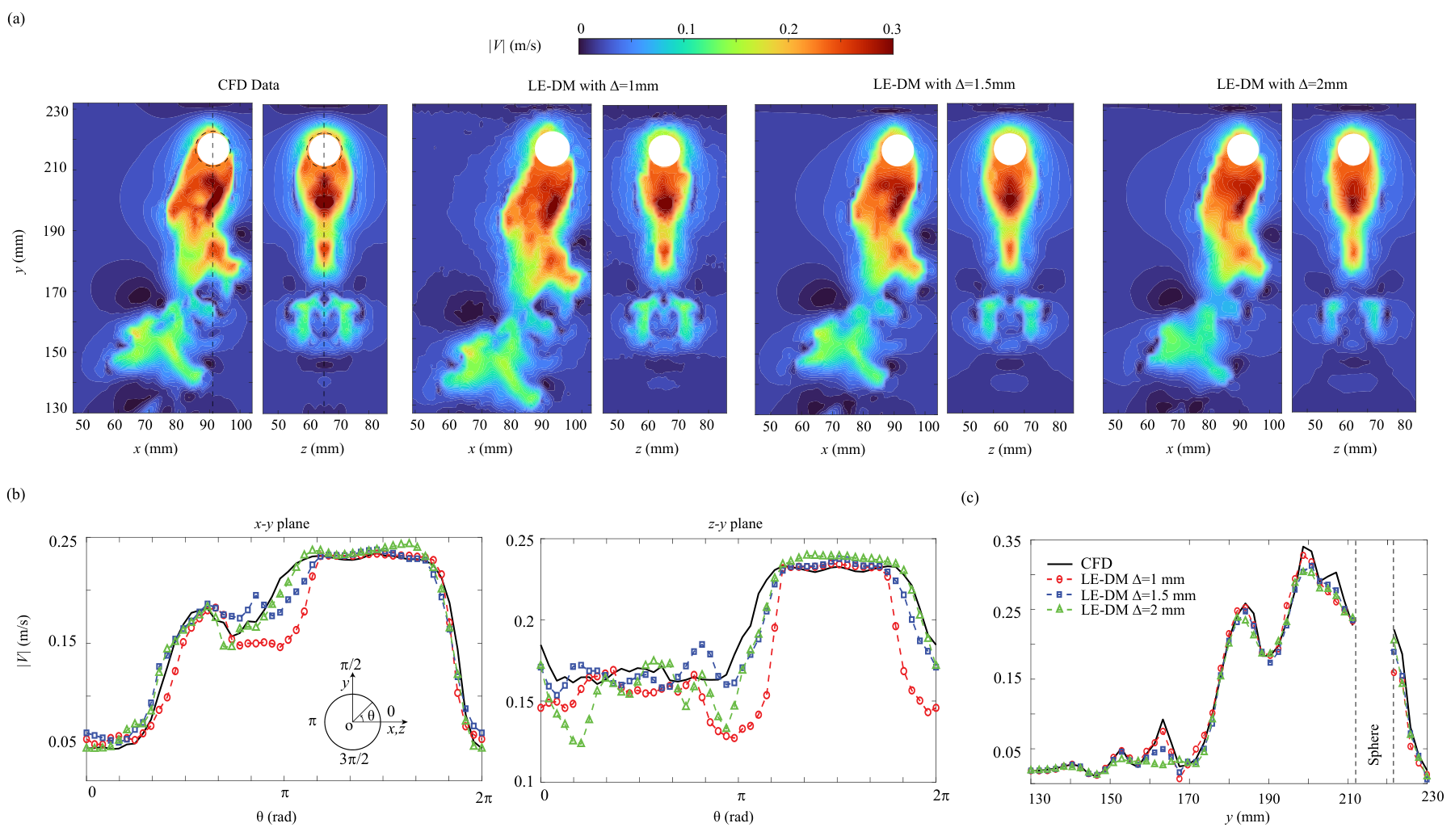
In the simplest controlled test, the error in the first layer of fluid next to the surface drops from about fourteen per cent of the body's own speed to about three. Coarsen the grid and the reconstruction degrades gently rather than falling apart, which matters because real measurements rarely give you the spacing you would like.
The correction is local. Far from the body nothing changes, which is the point.
Not just spheres
A tumbling body works too
An elongated body whose orientation changes every frame, not only its position.
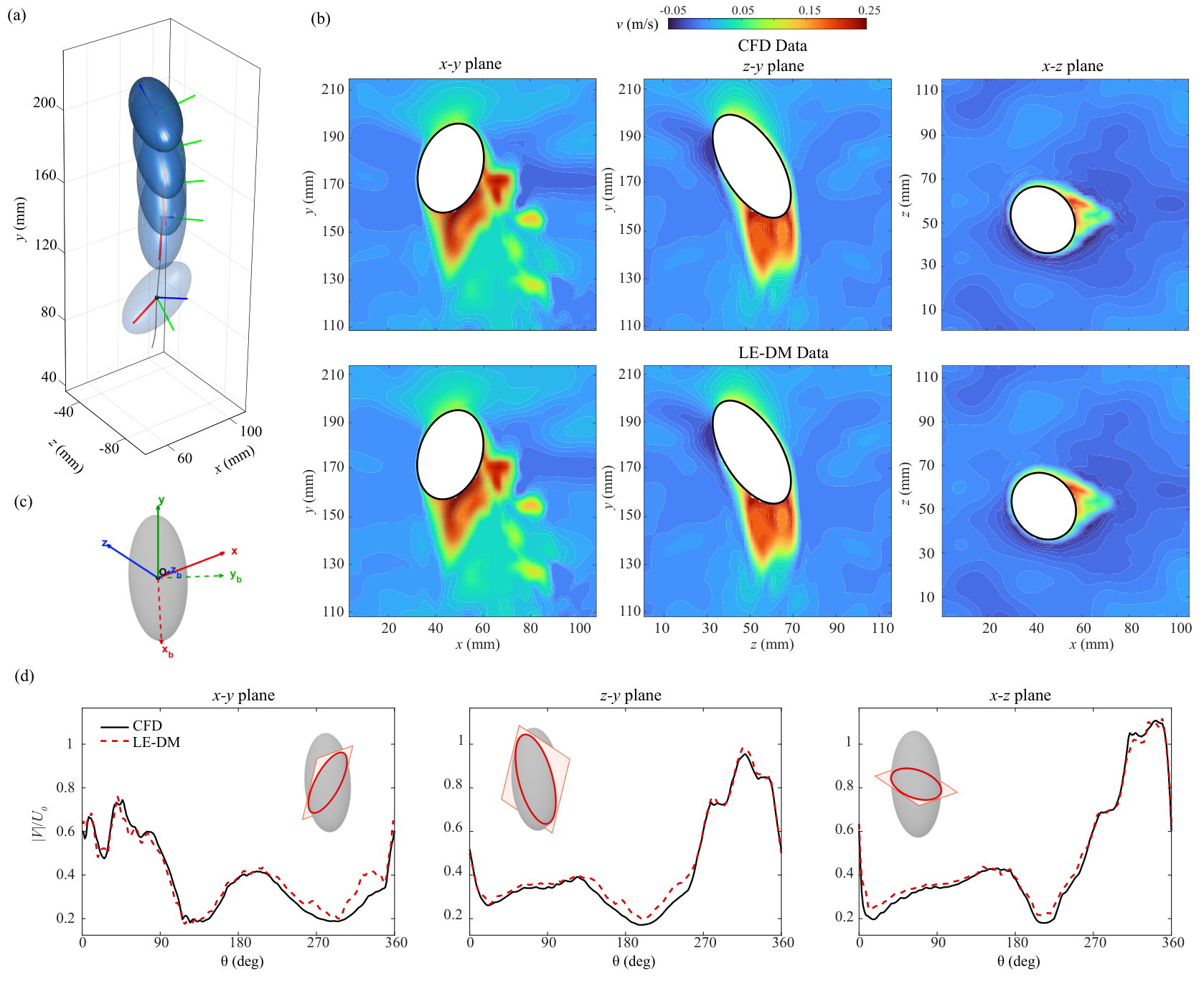
A sphere is a forgiving test: it looks the same from every side. A tumbling body is not, because both where it is and which way it points change from frame to frame. The same handling covers fixed walls, several bodies at once, and bodies that spin.
Anything whose shape and motion you know can be handled the same way.
Use it
Code and data
It runs on a desktop: roughly four and a half seconds per snapshot on a single processor core.
Measurement Science and Technology (2026), accepted
Dynamic masking for boundary-aware velocity reconstruction in volumetric particle tracking with moving solids
This work was partially funded by the American Chemical Society Petroleum Research Fund (grant 65901-ND9). Jibu Tom Jose was supported by a Technion postdoctoral fellowship.