Shocks through a narrowing, published in the Journal of Fluid Mechanics
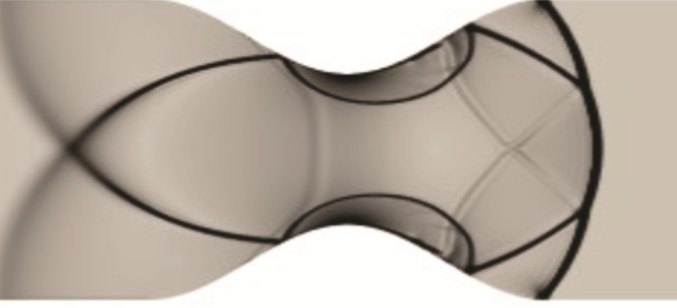
Raz Heppner, Hemanth Chandravamsi, Yoav Gichon, Steven Frankel and Omri Ram follow a shock wave through a short narrowing in a straight duct, using large-eddy simulations validated against time-resolved schlieren imaging and wall-pressure measurements in the lab’s shock tube. Abrupt rectangular and smoothly contoured sinusoidal constrictions are compared over a range of blockage ratios and lengths, at incident Mach numbers of 1.4 and 1.8.
The flow inside the constriction takes one to two orders of magnitude longer to settle than the shock needs to pass through it, and in the smooth geometries it settles along two different routes: in longer constrictions an attached transonic flow separates when a standing shock forms, while in shorter ones an already separated jet accelerates to sonic speed. The late-time reflected and transmitted shocks nevertheless depend almost only on the blockage ratio. The reason is choking at an effective sonic area, a single condition that predicts both shock strengths from the geometry and incident shock alone, without fitted constants, to within about one per cent for the reflected shock and a few per cent for the transmitted one. A geometrical shock-dynamics formulation corrected for the reflection reproduces how the transmitted shock approaches this limit for the smooth contours.
“Shock propagation through a local constriction” is published in the Journal of Fluid Mechanics 1044, A21 (doi). The article is open access.