
Research Compressible flows and shock waves
Shock waves and porous media
Stiff porous media act as a first-order low-pass filter on the pressure pulse that follows a shock, which lets us predict the load on a protected wall without new experiments.
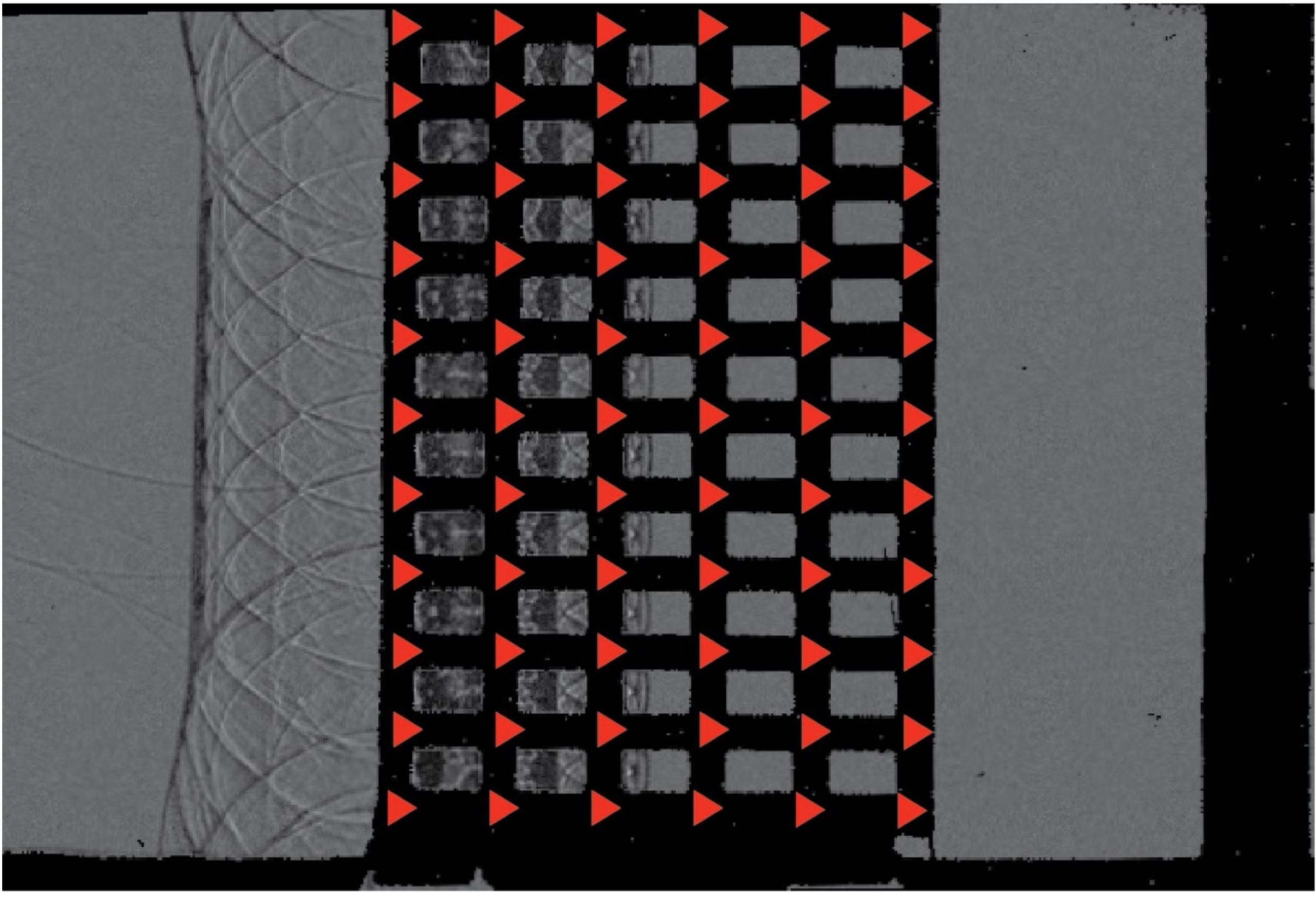
Shock wave attenuation by rigid porous media is widely used in protective structures. As a shock passes through a porous layer, diffraction and viscous effects attenuate and weaken the transmitted shock, reducing the load that develops on the target wall behind the protective layer.
In this study the parameters governing the pressure build-up on the target wall are investigated experimentally in a shock tube. Different porous samples are impinged by normal shock waves of various strengths and the pressure histories on the target wall are recorded, for a range of standoff distances between the sample and the wall.
What we found. Assuming that the flow through the porous medium is close to isentropic lets us develop a general constitutive model for the pressure history on the target wall: the stiff porous medium behaves as a first-order low-pass filter acting on the incoming pressure pulse. The model predicts the pressure build-up for any pressure history imposed on the front face of the sample, without the need to run large numbers of experiments. Later work extends the same ideas to arrays of perforated plates, where the spacing between plates creates resonant cavities that change the reverberation pattern.