
Research Multiphase and index-matched flows
Oil–water separation and thin water films
Water droplets crossing an oil–water interface are wrapped in a film that persists thousands of times longer than the crossing itself, with consequences for oil-spill dynamics.
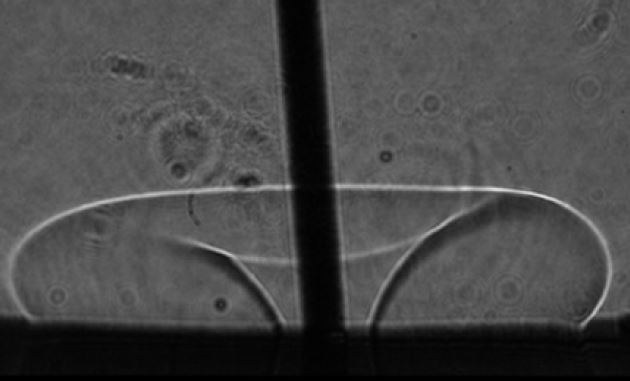
Understanding the physics of gravity-induced oil–water separation beneath a surface slick after an oil spill is essential for predicting the dynamics of the slick and the efficacy of treatment methods. When an oil droplet rises toward the slick, it is stopped by a layer of water separating it from the slick. High-speed holographic imaging shows that as this water layer breaks up and recedes, it leaves behind a very thin continuous water film, confirmed by planar laser-induced fluorescence. The film engulfs the droplet and prevents it from mixing with the bulk oil for a duration three to four orders of magnitude longer than the crossing itself.
The film forms for a range of oil and water pairs, including refractive-index-matched sugar water with silicone oil, and pure water with silicone oil and with hexadecane. It is therefore an inherent property of the oil–water interface and does not depend on surfactants.
After crossing, the water-coated droplet slowly spreads along the interface and creates surface kinks where the film eventually breaks up into a cloud of sub-micron droplets. This slow process is driven by electrostatic attraction between the film segments and the bulk water near the interface. The time scale of the whole process, from crossing to eventual mixing, grows with the viscosity of the fluids, from seconds for a 1 cSt oil to nearly an hour for a 50 cSt oil. When many droplets cross, they form a layer that does not mix with the bulk oil and contains segments of the thin films, presumably affecting the dynamics of the entire slick.