
Research Multiphase and index-matched flows
Inception of attached cavitation
Why attached cavitation on curved surfaces is insensitive to free-stream nuclei: microbubbles trapped near the wall keep seeding new events.
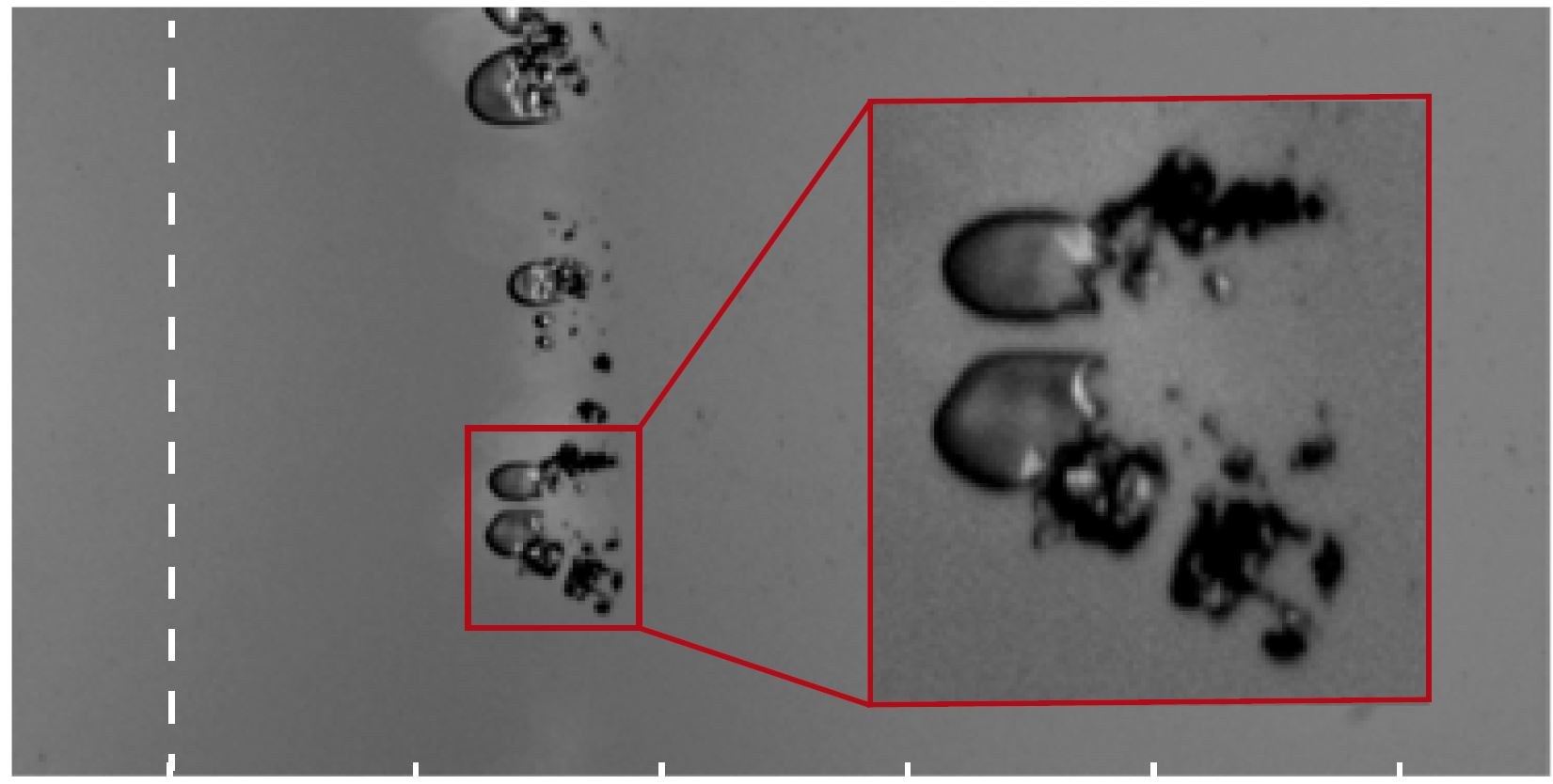
This experimental study addresses a long-standing question: why is the inception of attached cavitation on curved surfaces, or on hydrofoils at incidence, relatively insensitive to the concentration of free-stream nuclei? High-speed imaging and high-resolution PIV examine cavitation inception on three curved surfaces with different pressure minima followed by regions of adverse pressure gradient.
When these pressure gradients either thicken the boundary layer or cause local flow separation, thin (50–60 micron) low-momentum zones form close to the wall. Microbubbles trapped in these zones are generated initially by the collapse of intermittently attached traveling bubble cavitation. They migrate slowly upstream for a few milliseconds, driven by the adverse pressure gradient when the flow remains attached or carried by the recirculating flow when the boundary layer is separated. Their speed is only 2–4% of the free-stream velocity and their trajectories are erratic, indicating near dynamic equilibrium.
Owing to the low local pressure, the microbubbles grow by two to four times through diffusion of non-condensable gas, from 10–30 microns to the thickness of the low-momentum zone. They are then either swept downstream or become nuclei for new attached cavitation events. When the new patches collapse, new microbubbles form and the process repeats itself frequently, independently of the free-stream nuclei. None of this happens when the adverse pressure gradient is too mild to create a low-momentum zone thick enough for the slow upstream migration and growth.